
Autonomous Driving Explained: Technical Overview of SAE Levels 0–5
TechnoVita.net
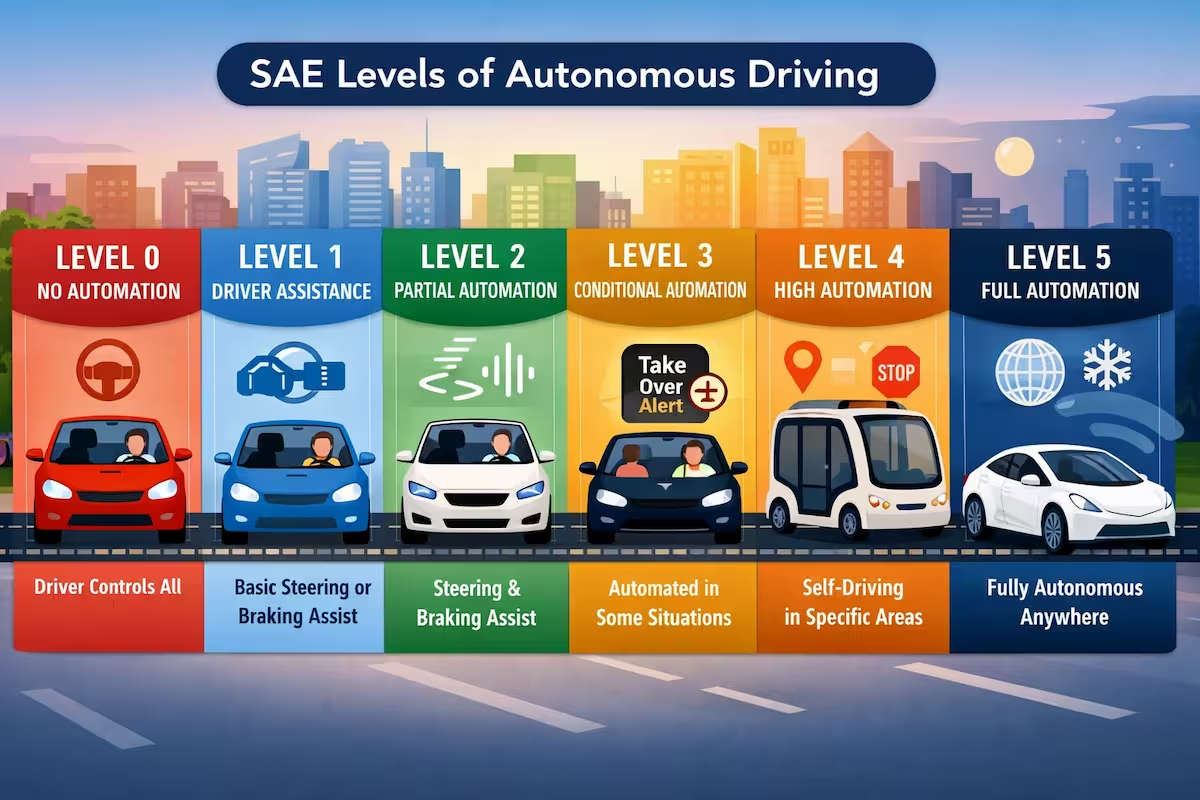
Autonomous driving systems represent a multidisciplinary integration of control theory, artificial intelligence, sensor technology, and software engineering. To standardize functionality and responsibility allocation between human drivers and automated systems, the Society of Automotive Engineers (SAE) defined six levels of driving automation, ranging from Level 0 (no automation) to Level 5 (full automation). This article examines the technical characteristics of each level, the historical development of autonomous driving, the current state of the art, and expected future advancements.
2. Early Vehicle Automation: Levels 0 and 1
2.1 Level 0 – No Driving Automation
At Level 0, all dynamic driving tasks (DDT), including lateral and longitudinal control, are performed by the human driver. Technological support is limited to passive or advisory systems such as forward collision warnings or lane departure alerts. These systems rely on basic sensor inputs but lack closed-loop control over vehicle actuators.
2.2 Level 1 – Driver Assistance
Level 1 introduces single-axis automation, where either lateral control (steering) or longitudinal control (acceleration and braking) is automated. From a technical standpoint, these systems use feedback control loops based on sensor inputs such as radar for adaptive cruise control or camera-based lane detection for steering assistance. System complexity remains relatively low, and fault tolerance requirements are minimal, as the driver maintains full situational awareness.
3. Increasing System Complexity: Levels 2 and 3
3.1 Level 2 – Partial Driving Automation
Level 2 systems can simultaneously control both lateral and longitudinal vehicle motion. These systems rely heavily on sensor fusion, combining data from cameras, radar, and sometimes lidar to construct a real-time environmental model. Machine learning algorithms, particularly convolutional neural networks (CNNs), are commonly used for object detection and lane recognition.
Despite these capabilities, the driver is still responsible for monitoring the environment. A major technical limitation at this level is the absence of reliable driver state monitoring and true environmental understanding, which prevents the system from handling complex edge cases independently.
3.2 Level 3 – Conditional Driving Automation
Level 3 marks a fundamental shift in system responsibility. The automated driving system (ADS) performs the entire DDT within a defined operational design domain (ODD), such as highway driving under favorable conditions. Unlike Level 2, the system must detect objects, predict their behavior, and plan trajectories autonomously.
Technically, Level 3 requires:
- Redundant sensor architectures
- High-reliability perception and prediction models
- Fail-operational system design
A critical challenge is the human–machine interface (HMI) during takeover requests. Research shows that driver re-engagement times can exceed safe limits, making system validation and regulatory approval particularly complex.
4. Advanced Autonomy: Levels 4 and 5
4.1 Level 4 – High Driving Automation
Level 4 systems are capable of full autonomy within constrained environments or geofenced areas. These vehicles are designed to operate without human intervention and can execute a minimal risk maneuver, such as safely stopping, if system limits are reached.
From a technical perspective, Level 4 systems depend on:
- High-definition semantic maps
- Multi-modal sensor redundancy (lidar, radar, cameras)
- Advanced motion planning and decision-making algorithms
Examples include autonomous shuttles and robotaxi platforms operating in urban test zones. At this level, system safety is achieved through redundancy rather than driver fallback.
4.2 Level 5 – Full Driving Automation
Level 5 represents unrestricted autonomy under all environmental and traffic conditions. Technically, this requires generalized artificial intelligence capable of handling rare and unpredictable scenarios, such as extreme weather, complex human behavior, and infrastructure variability.
Currently, Level 5 remains a theoretical target. Limitations include insufficient training data for edge cases, high computational demands, and unresolved ethical and legal challenges. Achieving Level 5 would require a paradigm shift in AI robustness and system verification.
5. Current State and Future Developments
At present, commercial vehicles predominantly operate at Level 2, with early Level 3 deployments emerging in limited markets. Research and development efforts are focused on improving perception accuracy, system redundancy, and validation methodologies.
Future advancements are expected in:
- End-to-end AI architectures
- Vehicle-to-everything (V2X) communication
- Formal verification of safety-critical software
In the medium term, Level 4 applications are likely to expand in controlled environments, while Level 5 autonomy remains a long-term objective.
6. Conclusion
The progression from Level 0 to Level 5 autonomous driving reflects a steady increase in system autonomy, technical complexity, and safety requirements. While significant progress has been made in perception and control, full automation remains constrained by technical, regulatory, and societal challenges. Continued advances in AI, sensing, and system engineering will be critical to realizing higher levels of autonomous mobility.
Overview of SAE Levels of Driving Automation
| SAE Level | Automation Name | System Control | Driver Responsibility | Technical Characteristics |
|---|---|---|---|---|
| Level 0 | No Automation | None (human controls steering and speed) | Full responsibility for all driving tasks | Warning-only systems, no actuator control |
| Level 1 | Driver Assistance | Either steering or acceleration/braking | Continuous monitoring and control required | Single-axis control, basic feedback loops |
| Level 2 | Partial Automation | Steering and acceleration/braking | Driver supervises environment and system | Sensor fusion, ADAS, ML-based perception |
| Level 3 | Conditional Automation | Full control within defined ODD | Driver responds to takeover requests | Redundant sensors, autonomous perception & planning |
| Level 4 | High Automation | Full control within geofenced or limited environments | No driver intervention within ODD | Fail-operational design, HD maps, AI decision-making |
| Level 5 | Full Automation | Full control in all conditions | No driver required | Generalized AI, full system redundancy |
You can read all comments, but you must log in to post or reply.
No comments yet. Be the first to react!