
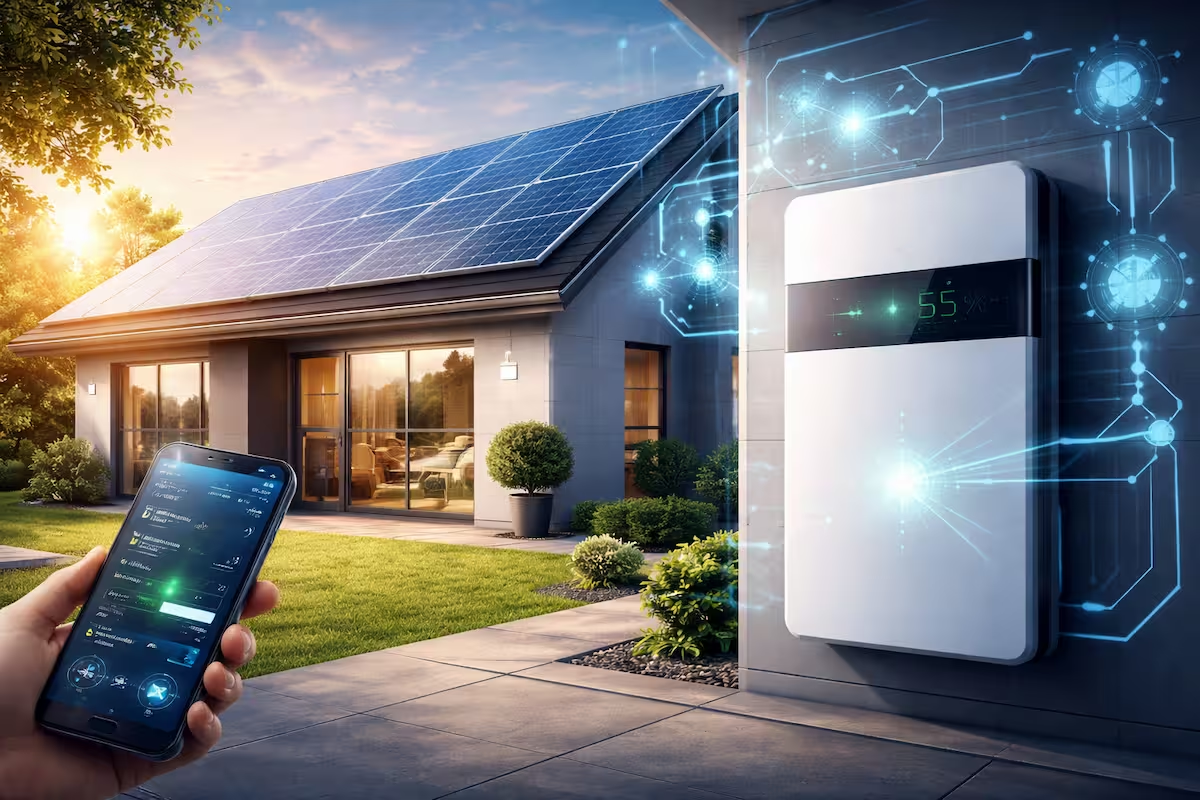
Sustainable AI Innovation in Home Battery Technology
TechnoVita.net
As the global energy transition accelerates, artificial intelligence (AI) is becoming a key driver in improving how households store and use renewable energy. Home battery systems — paired with solar panels and smart management software — are evolving rapidly. Today’s innovations not only help homeowners reduce their environmental impact, but also help stabilize energy grids and promote energy independence.
This article explores sustainable AI innovations in home battery technology, with real-world examples of how these systems are being deployed and optimized in 2025 and beyond.
The Role of AI in Home Energy Storage
Home batteries allow households to store excess renewable energy — usually from rooftop solar panels — and use it when needed. But without smart control, these systems can be inefficient, discharging energy at suboptimal times or relying too much on grid electricity. AI changes this by analyzing data such as energy production, weather forecasts, consumption patterns, and electricity price signals to make real-time decisions about when to charge, discharge, or trade energy. This leads to higher self-consumption, lower costs, and reduced reliance on fossil-fuel-generated power.
Planetpod: A Dutch AI-Powered Home Battery
A compelling recent example comes from the Netherlands. Planetpod, a Dutch startup, has begun delivering the first locally manufactured AI-powered home batteries to consumers. Unlike traditional “dumb” storage units that simply hold energy, Planetpod’s system uses AI algorithms to optimise charging and discharging based on energy prices, household use, and grid conditions.
The system can even sell stored energy back to the grid under favourable pricing conditions, allowing homeowners not just to save energy, but also to generate income. The first 300 units were delivered in late 2025, marking a significant milestone in the adoption of intelligent, sustainable storage solutions in the Dutch residential market.
Tesla Powerwall and AI Optimization
Internationally, established products like the Tesla Powerwall also integrate AI to enhance performance. The Powerwall system uses machine learning to learn a household’s energy patterns, optimise the timing of battery charging and discharging, and maximise the usage of solar energy. This not only reduces dependency on the grid during peak hours but also lowers electricity bills and carbon emissions.
By collecting and analyzing real-time data, the AI can predict when solar production will be highest or when grid prices are lowest, making solar storage more efficient and economically attractive.
AI-Enhanced Smart Home Energy Management with EcoFlow
Another example of sustainable AI innovation is the EcoFlow PowerOcean system. EcoFlow uses AI-based energy management software (often referred to as a Home Energy Management System, or HEMS) to optimise how solar energy and stored power are used within the home. The AI can monitor multiple data sources — from energy production to weather forecasts — enabling smarter decisions about when to draw from the battery, export to the grid, or conserve for future needs.
This type of intelligent management assists homeowners in reducing waste, lowering costs, and maximising the environmental benefits of renewable energy systems.
Virtual Power Plants and Grid Integration
Beyond individual homes, AI platforms like Capalo AI demonstrate how home batteries can participate in larger energy systems. Capalo’s technology creates virtual power plants by aggregating distributed energy storage resources and using AI to forecast energy generation and demand across many systems. This helps balance grid load, improve stability, and increase the value of stored energy for owners.
Such approaches illustrate an important evolution: home batteries are not just standalone devices, but integral parts of smart, AI-enabled energy networks.
Challenges and Future Outlook
While AI offers substantial benefits, integrating AI and battery systems also poses challenges. Ensuring data privacy, scaling technology for diverse markets, and aligning incentives between homeowners, utilities, and grid operators require thoughtful solutions. Regulations in many regions are evolving to support these innovations, and improvements in AI algorithms will continue to refine performance and sustainability outcomes.
Looking ahead to the late 2020s, we can expect AI to play an increasingly central role in optimising distributed energy resources, enhancing grid resilience, and supporting the transition to net-zero emissions.
Conclusion
AI-driven innovation in home battery technology represents a meaningful step toward more sustainable, efficient, and resilient energy systems. Through examples like Planetpod’s AI home battery, Tesla’s Powerwall, and EcoFlow’s smart energy management, we see how intelligence and storage combine to transform residential energy use. As these technologies mature and scale, they will play a vital role in the global renewable energy transition.
You can read all comments, but you must log in to post or reply.
No comments yet. Be the first to react!