
Sodium-Ion Batteries: A Promising Alternative to Lithium-Ion Technology
TechnoVita.net
As global demand for energy storage continues to grow, the limitations of lithium-ion batteries are becoming increasingly clear. Issues such as rising lithium costs, supply chain constraints, and environmental concerns have driven researchers and manufacturers to explore alternative technologies. One of the most promising options is the sodium-ion battery. Using sodium instead of lithium, this technology offers a potentially cheaper, safer, and more sustainable solution for large-scale energy storage.
How Sodium-Ion Batteries Work
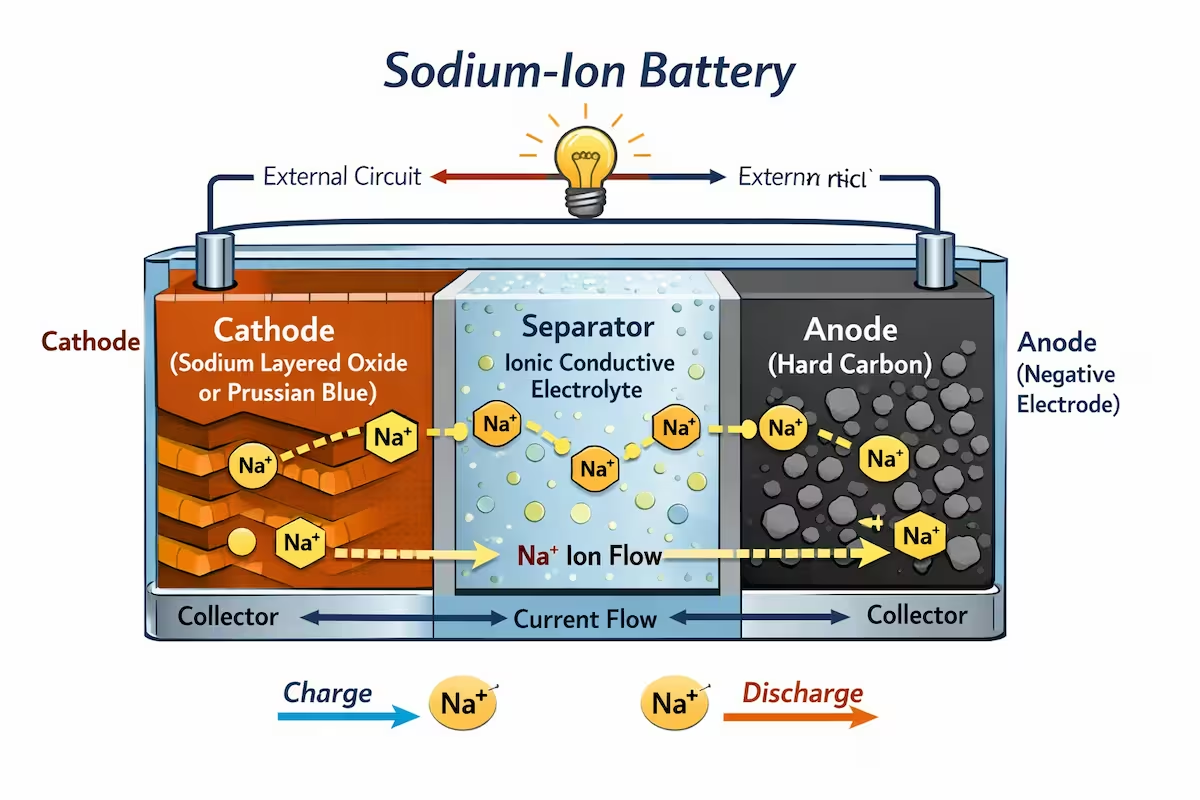
Sodium-ion batteries operate on the same basic principle as lithium-ion batteries. They store and release energy through the movement of ions between a cathode and an anode during charging and discharging cycles. The key difference lies in the charge carrier: sodium ions replace lithium ions. Because sodium atoms are larger and heavier than lithium atoms, the materials used for electrodes must be carefully engineered to allow efficient ion movement.
Advantages of Sodium-Ion Batteries
One of the biggest advantages of sodium-ion batteries is the abundance of sodium. Sodium can be extracted from seawater and widely available minerals, making it far more accessible and less expensive than lithium. This abundance significantly reduces raw material costs and geopolitical supply risks.
Another important benefit is safety. Sodium-ion batteries are generally less prone to overheating and thermal runaway, which lowers the risk of fire. In addition, they perform well at low temperatures, making them suitable for use in colder climates where lithium-ion batteries often struggle.
Performance Comparison with Lithium-Ion Batteries
From a technical perspective, sodium-ion batteries currently lag behind lithium-ion batteries in gravimetric and volumetric energy density. Typical commercial sodium-ion cells achieve:
- Energy density: 100–160 Wh/kg
- Lithium-ion comparison: 180–250 Wh/kg
However, sodium-ion batteries offer competitive performance in other areas:
- Cycle life: 3,000–6,000 cycles (depending on chemistry)
- Lithium-ion average: 2,000–4,000 cycles
- Operating temperature range: −20°C to +60°C
- Lithium-ion typical range: 0°C to +45°C
In terms of cost, sodium-ion batteries have a significant advantage. Due to the abundance of sodium and the absence of critical materials such as cobalt and nickel, cell-level costs are estimated at 20–40% lower than lithium-ion batteries when produced at scale.
Challenges and Limitations
Despite their potential, sodium-ion batteries are not without challenges. Their energy density is currently lower than that of lithium-ion batteries, meaning they store less energy for the same weight or volume. This makes them less suitable for applications where compact size and low weight are critical, such as electric vehicles with long driving ranges.
Furthermore, sodium-ion technology is still in a relatively early stage of commercialization. While pilot projects and early production lines exist, large-scale manufacturing and long-term performance data are still developing.
Applications and Future Outlook
Sodium-ion batteries are particularly well-suited for stationary energy storage, such as grid balancing and renewable energy integration. Their lower cost and longer cycle life make them attractive for storing solar and wind energy. They are also being considered for short-range electric vehicles, electric scooters, and backup power systems.
As research progresses, improvements in electrode materials and cell design are expected to increase energy density and efficiency. With continued investment, sodium-ion batteries could become a key component of a more resilient and sustainable energy storage ecosystem.
Conclusion
Sodium-ion batteries are not a direct replacement for lithium-ion batteries in all applications, particularly where high energy density is essential. However, from a technical and economic standpoint, they represent a strong alternative for stationary and cost-sensitive energy storage. With proven real-world applications and measurable performance advantages in safety and sustainability, sodium-ion technology is poised to become a key pillar of the future energy infrastructure.
You can read all comments, but you must log in to post or reply.
No comments yet. Be the first to react!