
Artificial Intelligence in Healthcare: Technologies, Applications, and Clinical Impact
TechnoVita.net
Artificial Intelligence (AI) has become one of the most influential technological developments in modern healthcare. Driven by advances in machine learning, increased computing power, and the availability of large-scale medical data, AI is now deeply integrated into clinical practice, research, and healthcare operations. Rather than replacing clinicians, AI functions as an advanced decision-support tool that enhances accuracy, efficiency, and personalization of care.
Core AI Technologies Used in Healthcare
Machine Learning and Deep Learning
Machine learning (ML) systems learn patterns from structured and unstructured data without being explicitly programmed. In healthcare, ML models are commonly trained on electronic health records (EHRs), laboratory results, and imaging data. Deep learning, a subset of ML using neural networks with multiple layers, is particularly effective in image and signal analysis.
Convolutional Neural Networks (CNNs), for example, are widely used in radiology and pathology for image classification and segmentation. These models can identify tumors, fractures, or tissue abnormalities with high precision.
Natural Language Processing (NLP)
Healthcare data is largely unstructured, consisting of clinical notes, discharge summaries, and physician reports. Natural Language Processing enables AI systems to extract meaningful insights from this text-based data. NLP is used to identify symptoms, medications, diagnoses, and risk factors from clinical documentation, improving data quality and supporting clinical decision-making.
AI in Medical Imaging and Diagnostics
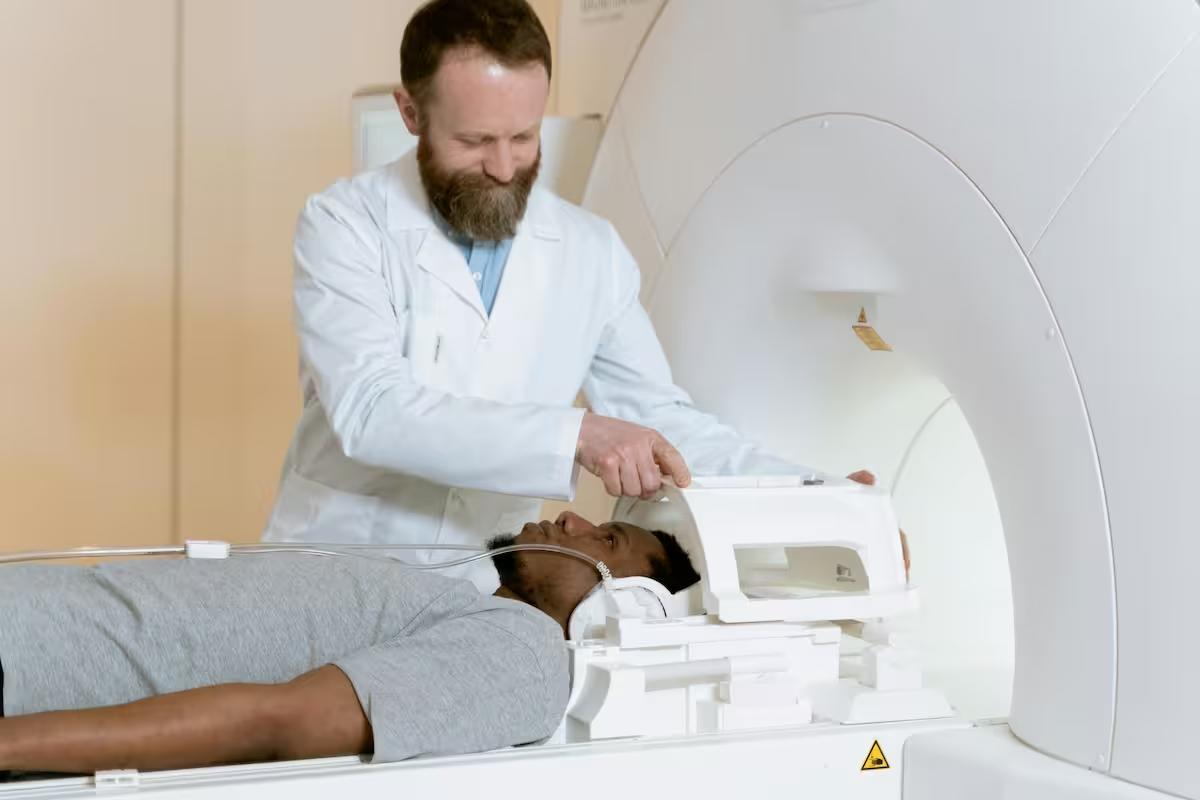
Medical imaging is one of the most mature application areas for AI in healthcare. AI-powered diagnostic systems analyze X-rays, CT scans, MRIs, and ultrasounds to detect diseases at an early stage.
For example:
- AI algorithms are used in mammography to detect early-stage breast cancer.
- Deep learning models assist in identifying diabetic retinopathy from retinal images.
- AI systems analyze chest CT scans to detect lung nodules and assess the severity of respiratory diseases.
These tools significantly reduce diagnostic workload and help clinicians prioritize high-risk cases, improving both speed and accuracy.
Predictive Analytics and Clinical Decision Support
AI-driven predictive analytics play a critical role in anticipating adverse events and supporting early intervention. By analyzing historical patient data, AI models can predict disease progression, hospital readmissions, or complications.
A well-known application is sepsis prediction. AI systems continuously monitor vital signs, lab results, and clinical notes to detect subtle changes that may indicate early sepsis. Early alerts allow clinicians to initiate treatment sooner, which can dramatically reduce mortality rates.
Clinical Decision Support Systems (CDSS) powered by AI also assist physicians in selecting diagnostic tests, medications, and treatment plans based on evidence-based guidelines and patient-specific factors.
Personalized and Precision Medicine
AI enables a shift from generalized treatment protocols to personalized medicine. By combining clinical data, genetic information, and treatment history, AI models help determine which therapies are most likely to be effective for individual patients.
In oncology, AI is used to:
- Analyze tumor genomics
- Predict response to chemotherapy or immunotherapy
- Recommend personalized treatment strategies
This approach improves treatment effectiveness while minimizing side effects and unnecessary interventions.
AI in Healthcare Operations and Administration
Beyond clinical applications, AI significantly improves healthcare operations. Administrative tasks consume a large portion of healthcare resources and contribute to staff burnout.
AI-powered automation is used for:
- Appointment scheduling and patient flow optimization
- Medical coding and billing
- Automated clinical documentation through speech recognition
Virtual assistants and chatbots provide 24/7 patient support by answering common questions, triaging symptoms, and sending medication reminders. This reduces administrative burden while improving patient engagement.
Remote Monitoring and Chronic Care Management
Wearable devices and Internet of Medical Things (IoMT) technologies generate continuous streams of patient data. AI analyzes this data to monitor chronic conditions such as diabetes, heart disease, and respiratory disorders.
Examples include:
- AI algorithms detecting irregular heart rhythms from wearable ECG sensors
- Predictive models identifying worsening heart failure based on weight and activity patterns
- Fall detection systems for elderly patients using motion sensors
These technologies support preventive care and enable early intervention outside traditional clinical settings.
Ethical, Regulatory, and Technical Challenges
Despite its potential, AI in healthcare presents significant challenges. Data privacy and security are major concerns, as AI systems rely on sensitive patient information. Compliance with regulations such as GDPR and HIPAA is essential.
Another challenge is algorithmic bias. If AI models are trained on non-representative datasets, they may produce inaccurate or unfair outcomes for certain populations. Transparency, explainability, and rigorous validation are therefore critical before clinical deployment.
Conclusion
Artificial Intelligence is transforming healthcare through advanced diagnostics, predictive analytics, personalized medicine, and operational efficiency. When implemented responsibly and ethically, AI enhances clinical decision-making and improves patient outcomes. As technology continues to evolve, collaboration between clinicians, data scientists, and policymakers will be essential to fully realize the benefits of AI while safeguarding patient trust and safety.
You can read all comments, but you must log in to post or reply.
No comments yet. Be the first to react!