
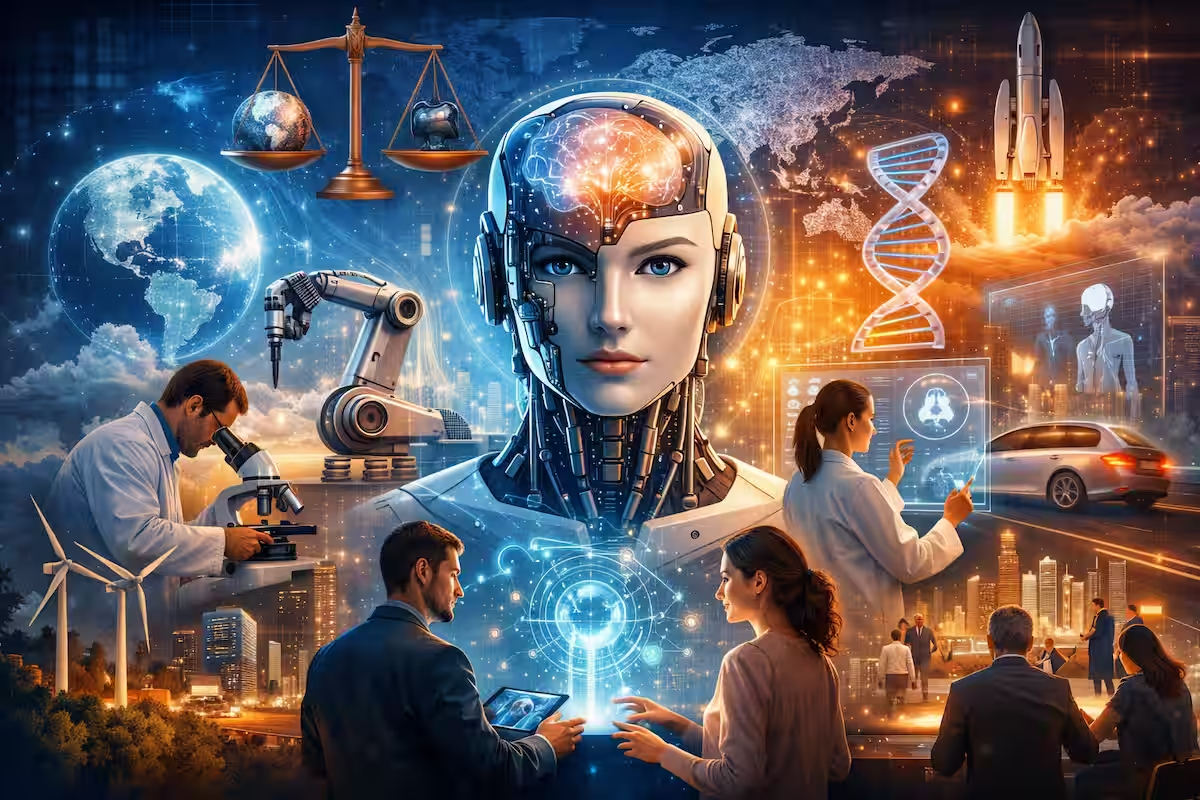
The Future of Artificial General Intelligence and Its Impact on Society
TechnoVita.net
Artificial Intelligence has already transformed many aspects of modern life, from recommendation systems and virtual assistants to medical diagnostics and autonomous vehicles. However, most existing AI systems are considered narrow AI: they are designed to perform specific tasks and cannot operate outside their predefined domains. The potential development of Artificial General Intelligence (AGI) marks a fundamental shift. AGI refers to machines that can understand, learn, and apply knowledge across a wide range of tasks at a level comparable to human intelligence. If AGI becomes possible, it could profoundly reshape society, the economy, and the way humans understand intelligence itself.
What Makes AGI Different from Today’s AI?
Current AI systems excel in pattern recognition and data processing, but they lack true understanding, reasoning across contexts, and common sense. AGI, by contrast, would be capable of transferring knowledge from one domain to another, learning autonomously, and adapting to new situations without explicit programming. This flexibility would allow AGI to solve complex, real-world problems that today require human judgment. The emergence of AGI would therefore not be an incremental improvement, but a qualitative leap in machine intelligence.
Economic Transformation and the Future of Work
One of the most significant impacts of AGI would be on the global economy. Unlike narrow AI, which mainly automates routine or specialized tasks, AGI could perform both manual and cognitive labor. Professions in law, medicine, engineering, education, and research could be deeply affected. While this raises concerns about large-scale job displacement, it also opens the door to unprecedented productivity growth.
AGI could take over repetitive and complex tasks, allowing humans to focus on creativity, strategy, and interpersonal work. New industries and job categories may emerge, particularly in fields related to AI governance, human-AI collaboration, and ethical oversight. The challenge for societies will be managing this transition in a way that reduces inequality and ensures that the benefits of AGI are widely shared.
Scientific Progress and Problem Solving
AGI could dramatically accelerate scientific discovery. With the ability to analyze vast datasets, generate hypotheses, and design experiments across disciplines, AGI might help solve problems that have resisted human efforts for decades. Breakthroughs in climate modeling, drug discovery, energy production, and materials science could become more frequent and faster.
In medicine, AGI could provide highly personalized treatment plans, predict diseases before symptoms appear, and assist in developing cures for complex conditions. In environmental science, it could optimize resource use and propose innovative solutions to mitigate climate change. In this sense, AGI has the potential to become one of humanity’s most powerful tools for addressing global challenges.
Ethical and Safety Considerations
The development of AGI also raises serious ethical and safety concerns. A system with general intelligence could make decisions with far-reaching consequences, especially if its goals are misaligned with human values. Issues such as accountability, transparency, and control become increasingly complex when dealing with an entity that can reason and act autonomously.
There is also the risk of misuse. AGI could be employed for surveillance, manipulation, or autonomous weapons if not properly regulated. As a result, international cooperation, robust governance frameworks, and ongoing ethical research will be essential. Ensuring that AGI is developed and deployed responsibly may be as important as the technology itself.
Human Identity and the Meaning of Intelligence
Beyond practical impacts, AGI would challenge fundamental ideas about what it means to be human. If machines can reason, learn, and create in ways similar to humans, the distinction between human and artificial intelligence becomes less clear. This could lead to philosophical debates about consciousness, moral status, and the rights of intelligent machines.
Rather than replacing humans, AGI may ultimately redefine human identity by highlighting uniquely human qualities such as empathy, values, and purpose. The future may involve deep collaboration between humans and intelligent machines, where each complements the strengths of the other.
Conclusion
The possibility of Artificial General Intelligence represents one of the most transformative prospects in technological history. AGI could revolutionize economies, accelerate scientific progress, and help solve some of the world’s most pressing problems. At the same time, it introduces significant ethical, social, and philosophical challenges. The future of AI in an AGI-enabled world will depend not only on technical breakthroughs, but also on the choices humanity makes about governance, responsibility, and shared values. If guided wisely, AGI could become a powerful ally in shaping a more prosperous and sustainable future.
You can read all comments, but you must log in to post or reply.
No comments yet. Be the first to react!